
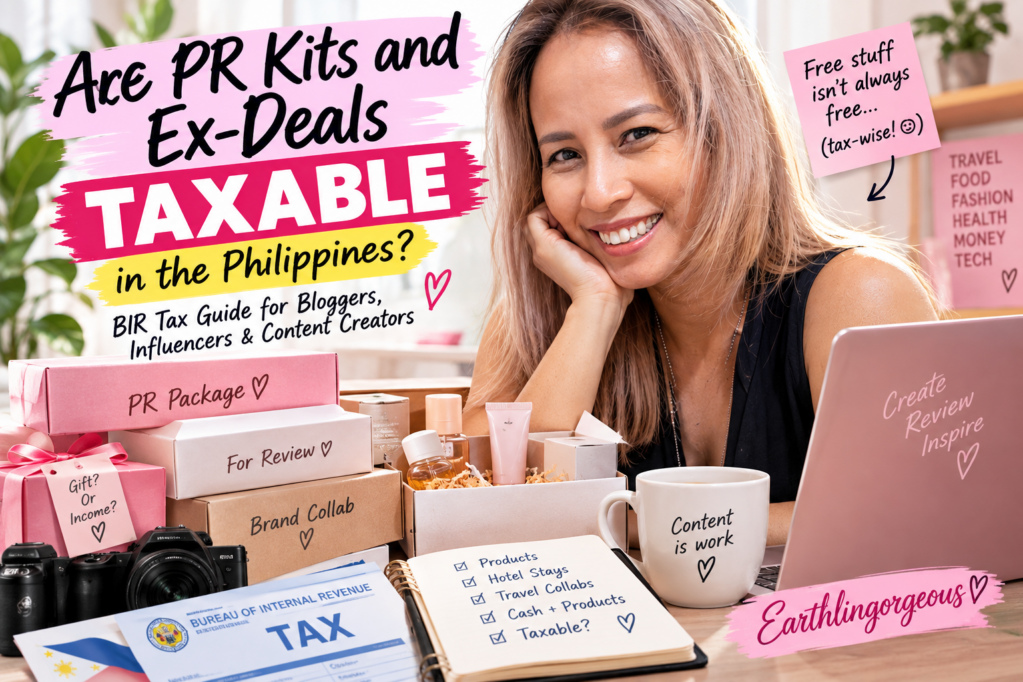
Are PR Kits and Ex-Deals Taxable in the Philippines? Here’s What Bloggers and Influencers Need to Know.
That free skincare set, complimentary hotel stay, or gadget delivered to your doorstep might come with an unexpected question: Do you have to pay taxes on PR kits and ex-deals in the Philippines? In short, generally PR Kits and Ex-Deals ,Taxable.
If you’re a blogger, vlogger, influencer, or social media content creator, you’ve probably received products from brands hoping you’ll feature them on your blog, Instagram, TikTok, Facebook, or YouTube channel.
Sometimes, you get paid in cash. Other times, the brand offers free products in exchange for a review or social media post. And sometimes, a PR agency sends you a package without requiring you to publish anything.
Are these arrangements treated the same way for tax purposes? Not necessarily.
The Bureau of Internal Revenue (BIR) has issued guidelines on income received by social media influencers, including compensation received in cash or in kind. Which they said generally PR Kits and Ex-Deals ,Taxable,
So before you declare every PR box as income—or assume that everything labeled gift is tax-free—let’s break down what bloggers and content creators in the Philippines need to know.
Are PR Kits Taxable in the Philippines?
What's Inside
PR kits may be taxable if you receive the products as compensation for promotional work. However, not every PR package automatically qualifies as taxable compensation.
The distinction depends on the actual arrangement.
Under BIR Revenue Memorandum Circular (RMC) No. 97-2021, income received by social media influencers in cash or in kind in exchange for promotional activities may be subject to tax.
In plain English, if a brand gives you a product in exchange for creating content, publishing a review, or promoting its business, the value of that product may be treated as compensation in kind.
For example, a brand pays you ₱10,000 to publish a sponsored blog post. That’s clearly payment for your services.
Now, what if the brand gives you a product worth ₱10,000 instead and asks you to publish the same post?
The fact that you received a product instead of cash doesn’t automatically make the arrangement tax-free.
But here’s the important distinction: A product you receive and keep as compensation is different from a product you borrow and return after reviewing it.
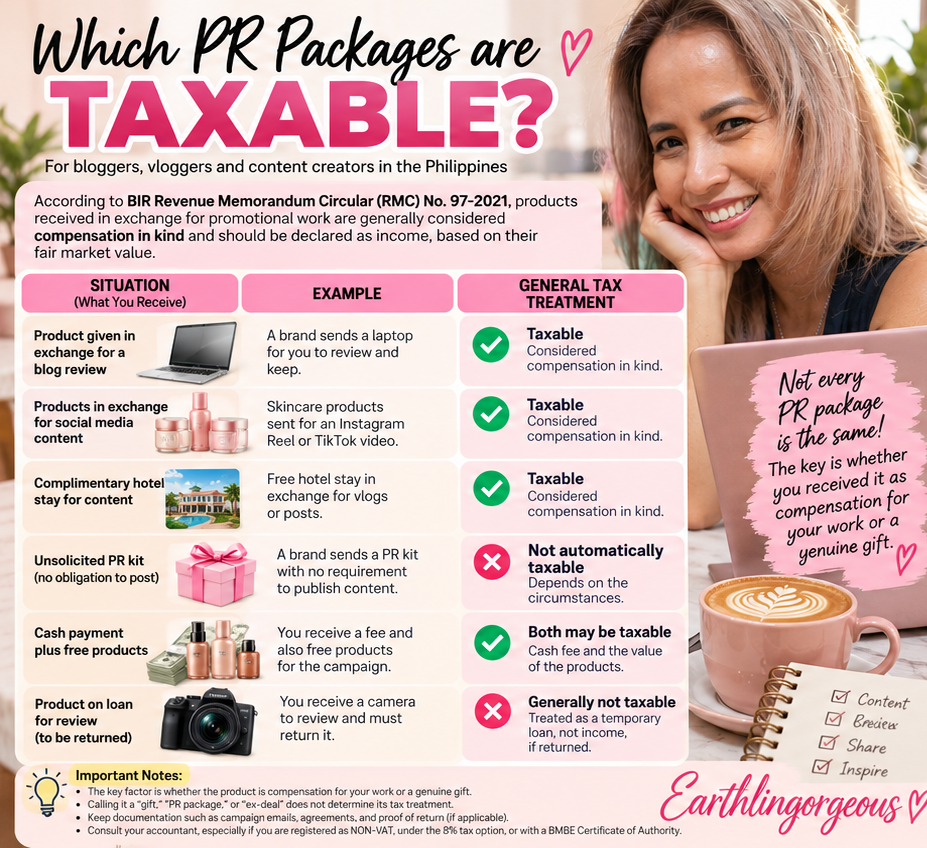
Which PR Packages Are Taxable? generally PR Kits and Ex-Deals ,Taxable
Here are common PR and brand collaboration scenarios and their general tax treatment.
1. Products Received in Exchange for a Blog Review
A brand sends you a laptop, beauty product, or kitchen appliance in exchange for a review on your blog.
General tax treatment: Potentially taxable.
If you get to keep the product as payment for your promotional work, its fair market value may be treated as compensation in kind and included in your business income, subject to the applicable tax rules.
2. Free Products in Exchange for Social Media Posts
A brand sends you skincare products and asks you to publish an Instagram Reel, TikTok video, or Facebook post.
General tax treatment: Potentially taxable.
If the products are yours to keep and were provided in exchange for your content, their value may count as income.
And no, calling the arrangement an ex-deal doesn’t automatically exempt it from taxes.
3. Complimentary Hotel Stays and Travel Collaborations
A hotel offers you a complimentary stay in exchange for a blog feature, social media posts, or a YouTube vlog.
General tax treatment: Potentially taxable.
The value of accommodation or other benefits received in exchange for promotional services may be treated as compensation in kind.
This is particularly relevant to travel bloggers, lifestyle influencers, and content creators working with hotels, resorts, tourism offices, and travel companies.
4. Unsolicited PR Kits With No Obligation to Post
A PR agency sends you a box of products without requiring a blog review, social media post, or other deliverable.
General tax treatment: Not automatically taxable as compensation for services.
The circumstances matter. Was the package a genuine gift? Was there an express or implied expectation that you would promote the brand? Was there an agreement, even an informal one?
An unsolicited PR kit isn’t automatically the same as payment for a sponsored post. Its treatment depends on the actual arrangement and applicable tax rules.
5. Cash Payment Plus Free Products
A brand pays you a talent fee and lets you keep additional products from the campaign.
General tax treatment: Both may be taxable.
Your cash fee is generally business income. The value of products provided as additional compensation may also need to be included.
For example, if you receive ₱5,000 for a campaign and keep products worth ₱3,000 as compensation, the potential gross income from the arrangement could be ₱8,000 before applying the relevant tax rules.
Keep records of both the cash payment and the products received.
6. Products for Review That Must Be Returned
Here’s a situation worth highlighting, especially for technology bloggers and product reviewers.
A brand lends you a laptop, smartphone, camera, or appliance. You test it, create your review, publish your content, and return the item as agreed.
General tax treatment: Generally not income equal to the product’s full value if it is genuinely a temporary loan.
If the product remains the brand’s property and you’re only borrowing it for review purposes, you generally wouldn’t treat its entire retail price as your income merely because you temporarily possessed it.
However, the arrangement must be genuine. A product described as a loan but actually transferred to you as compensation may receive different tax treatment.
Keep the campaign agreement or email confirming that the product is on loan, along with the return deadline and proof of return.
If the brand also pays you a review fee, that fee is generally taxable business income even if you return the product.
7. Consumable Products You Review and Keep
A brand sends you food, coffee, supplements, or skincare products that you use during the review and cannot reasonably return.
General tax treatment: Potentially taxable if provided as compensation for promotional work.
If the products are provided in exchange for content and you get to keep or consume them, their fair market value may be considered compensation in kind.
The fact that a product is consumable doesn’t automatically make it tax-exempt. Generally PR Kits and Ex-Deals ,Taxable,
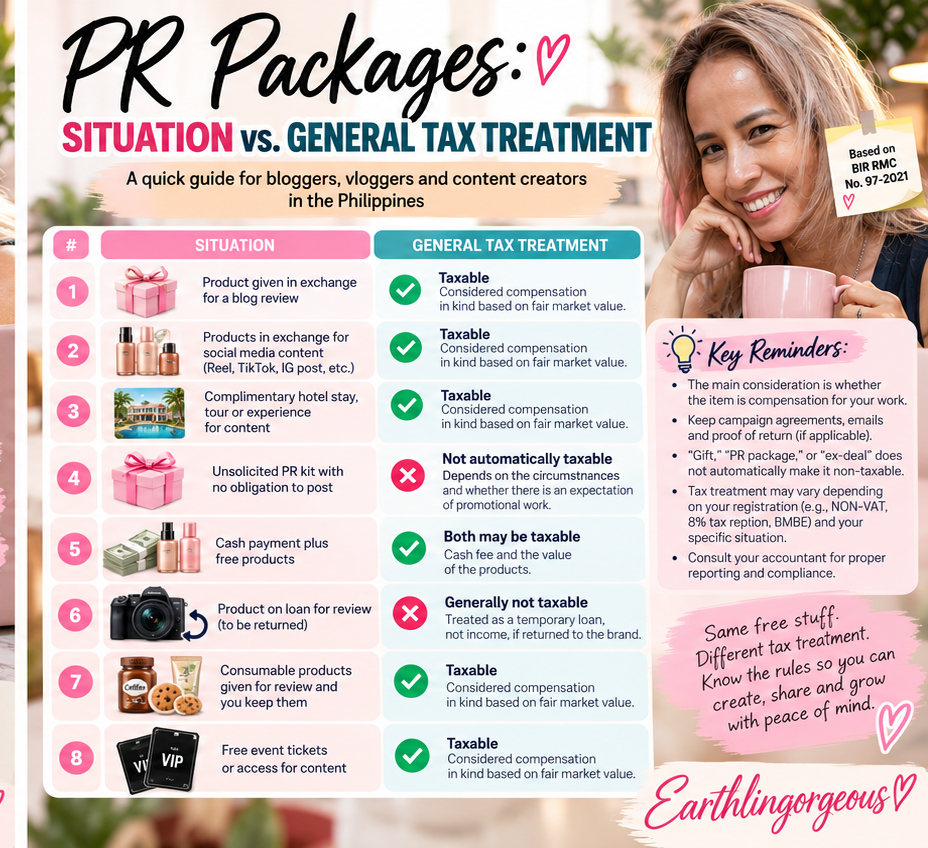
Quick Guide: PR Package Situations and Their Tax Treatment
Save this checklist if you’re a blogger, influencer, or content creator in the Philippines.
- Product given in exchange for a blog review: Generally taxable if kept as compensation.
- Products exchanged for social media content: Generally taxable if received as compensation in kind.
- Complimentary hotel stay in exchange for content: Potentially taxable based on the value and nature of the benefit.
- Unsolicited PR kit with no obligation to post: Not automatically taxable as service income; the circumstances matter.
- Cash payment plus free products: Both may be taxable.
- Product loaned for review and returned: Generally not income equal to the product’s full value if it remains the brand’s property.
- Consumable products received for review and kept: Potentially taxable when provided as compensation.
- Free event tickets or access in exchange for promotional work: Potentially taxable based on the value and nature of the benefit.
These are general guidelines. Your actual tax obligations depend on the facts of the arrangement and your applicable tax rules.
Do NON-VAT Bloggers and BMBE-Registered Content Creators Pay Taxes on PR Kits?
If you’re a small blogger or content creator running a registered business, you might be wondering whether your NON-VAT registration or Barangay Micro Business Enterprise (BMBE) Certificate of Authority changes the rules.
Let’s clarify a common misconception.
NON-VAT registration does not automatically mean you’re exempt from income tax.
Likewise, a BMBE certificate doesn’t automatically exempt every type of income or every tax obligation.
Qualified BMBEs may enjoy an income-tax exemption on income arising from their registered business operations, subject to applicable requirements. Other tax obligations may still apply.
Your tax treatment can also depend on whether you elected the 8% income tax option or another tax regime, as well as your BIR registration and the nature of the transaction.
If you receive PR packages regularly, ask your accountant how compensation in kind should be reported under your particular registration and tax treatment.
Don’t automatically assume that the retail price of every product delivered to you is taxable income. But don’t assume every product is tax-exempt just because no cash changed hands, either.
How Bloggers and Influencers Can Keep Their PR Tax Records Organized
You don’t need to turn every PR package into an accounting nightmare. A little documentation goes a long way.
Here are practical steps for content creators:
- Keep campaign emails and agreements. These can establish whether a product was compensation, a gift, or a temporary loan.
- Record the product’s value. Keep the brand’s stated value or other reasonable evidence of fair market value when relevant.
- Separate borrowed products from products you keep. Maintain an inventory of loaned gadgets and appliances, including return dates.
- Keep proof of return. Save shipping receipts, acknowledgment emails, or other evidence that the product was returned.
- Track cash fees and in-kind compensation separately. This helps you and your accountant determine the appropriate reporting treatment.
- Document unsolicited PR packages. Record whether there was any obligation or expectation to publish content.
- Consult a Philippine tax professional. This is especially important if you’re registered as NON-VAT, have a BMBE certificate, or elected the 8% income tax option.
What BIR Rule Should Bloggers and Influencers Read?
The key reference for influencer income is BIR Revenue Memorandum Circular No. 97-2021, which addresses income received by social media influencers in cash or in kind.
You can read the circular here:
BIR Revenue Memorandum Circular No. 97-2021 (PDF)
Keep in mind that the circular’s general treatment of promotional compensation does not, by itself, resolve every situation involving unsolicited gifts, temporary product loans, or other special arrangements.
For those cases, the underlying agreement and applicable tax rules matter.
The Bottom Line: Are Free PR Products Really Free?
Being a content creator is work. We pitch brands, test products, write reviews, shoot videos, edit content, and publish posts that help businesses reach their audiences.
Sometimes, we’re paid in cash. Sometimes, we’re compensated with products. Sometimes, we simply borrow equipment and return it after the review.
Those arrangements shouldn’t automatically be treated as identical.
The BIR’s rules on influencer income mean bloggers and creators need to pay attention to compensation received in kind. But that doesn’t mean every box delivered by a PR agency automatically becomes taxable income at its full retail price.
The key question is whether you received something as compensation for your work or merely borrowed an item that remains the brand’s property.
So, the next time a brand sends you a PR package, don’t panic—and don’t automatically assume it’s tax-free, either.
Read the agreement, document the arrangement, and know what you’re actually receiving.
Because creating content is already a full-time job. Understanding the tax side of it shouldn’t have to be another guessing game. So yeah, generally PR Kits and Ex-Deals ,Taxable,
So yeah, when I said affliliates, content creators , influencers getting asked to post stuff for free doesn’t really work. There is no such thing as FREE. I wasn’t being snubbish I was talking about the law especially for those who comply .
Disclaimer: This article is for general informational purposes only and does not constitute professional tax or legal advice. Tax treatment depends on the facts of each transaction and your circumstances. Consult a qualified Philippine tax professional for guidance.

