
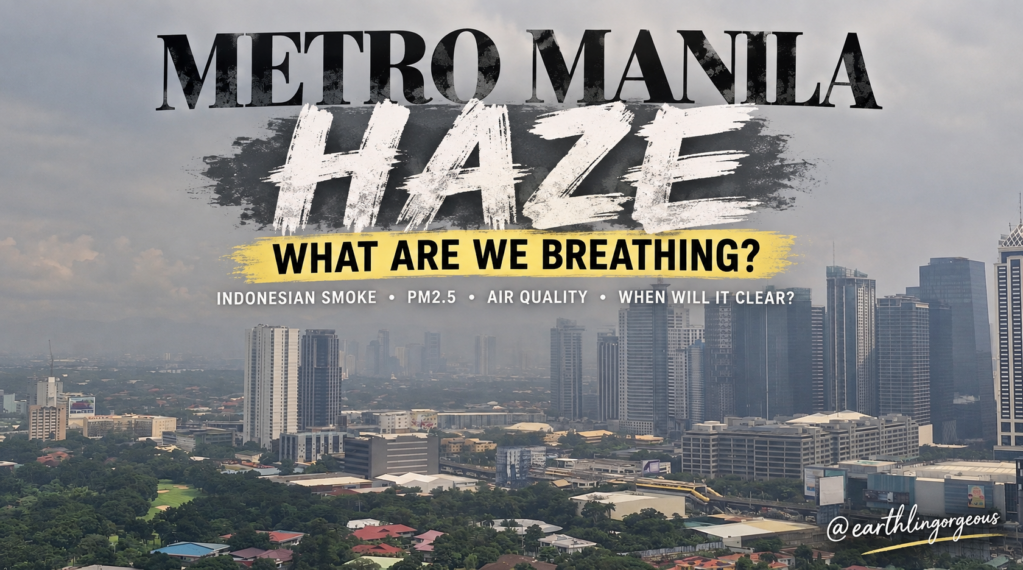
Stop scrolling for a second and look outside. Do you notice the Metro Manila Haze hovering above and around our skyline?
That weird gray, smoky-looking sky over Metro Manila isn’t just “maulap today.”
And if you’ve stepped outside recently and thought, “Why does the air feel different?” “Why are my eyes irritated?” or “Why does Manila suddenly look like this?” — you’re not imagining it.
There’s something in the air. Literally.
And before we collectively shrug and say “Philippines weather lang ‘yan,” here’s the part that should make you pay attention:
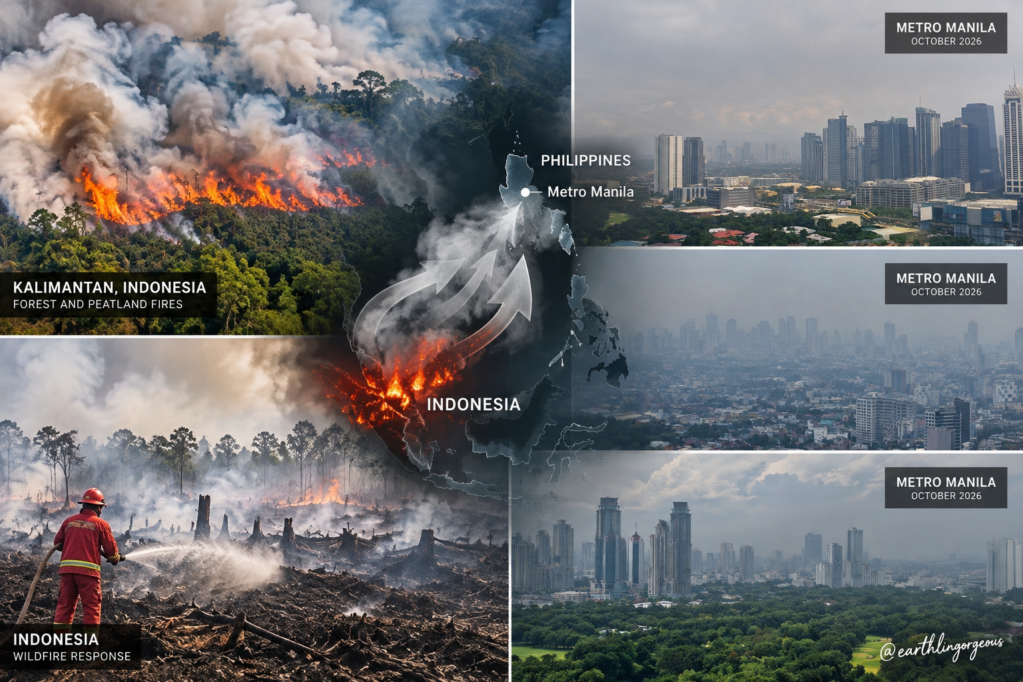
Some of the smoke affecting the Philippines has traveled all the way from Indonesia.
What's Inside
Yes. Indonesia.
We’re talking about wildfire smoke crossing national borders and mixing with pollution already being produced here in Metro Manila.
I’ve Been Watching the Metro Manila Skyline — And It’s Getting Worse
I’ve been watching the Metro Manila skyline since September 1, when the haze became visibly noticeable, and I’ve been taking photos because I wanted to see whether it was just a passing weather condition or something more. It hasn’t looked better from where I’m watching — if anything, the haze has become increasingly thick and the skyline increasingly obscured. And now the official numbers are giving that visual observation some serious context: on September 30, DENR-EMB monitoring showed several Metro Manila locations reaching the “very unhealthy” category for PM2.5, including readings as high as 184 in Las Piñas, 177 in Parañaque and 167 in Muntinlupa during the morning monitoring period. GMA Network By evening, Las Piñas and Parañaque were still classified as very unhealthy, while numerous other Metro Manila locations remained unhealthy for sensitive groups. GMA Network
And that’s the part that made me stop simply taking photos and start asking questions: What exactly are we breathing? Where is this smoke coming from? Why does the skyline seem to be disappearing? And, perhaps most importantly, how much worse does this have to get before we stop treating it as just another hazy Manila day?
So while you’re sitting in EDSA traffic, walking around BGC, heading to work in Makati, picking up the kids from school, exercising outdoors or simply opening your condo window because you want some “fresh air”…
You may not actually be getting fresh air.
And that’s where this gets serious.
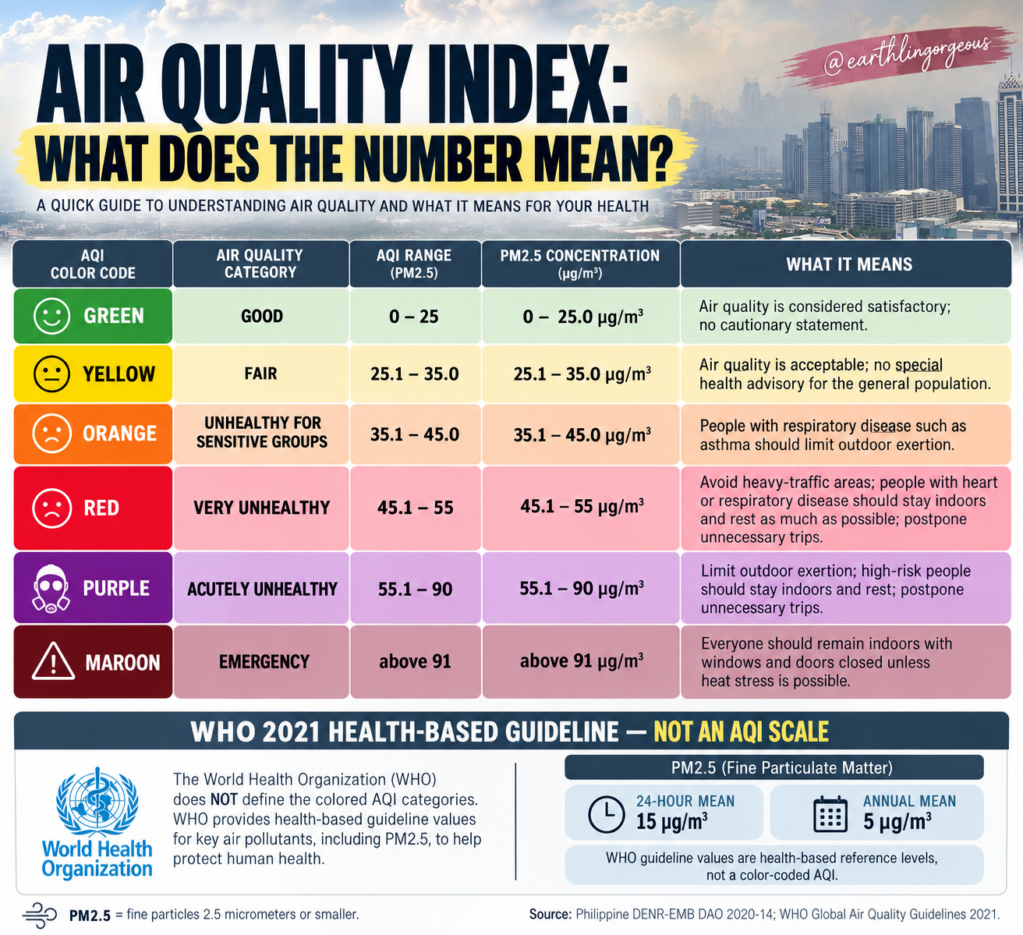
Recent air-quality monitoring has recorded very unhealthy and acutely unhealthy PM2.5 levels in parts of Metro Manila.
PM2.5 particles are tiny enough to travel deep into your respiratory system.
So this isn’t just about Manila looking ugly in photographs.
We’re talking about the air going directly into your lungs.
Suddenly that gray skyline doesn’t look quite so harmless, does it?
Wait. How unhealthy is Metro Manila’s air right now?
Let’s not panic.
But let’s also not pretend this is nothing.
Recent monitoring by the DENR Environmental Management Bureau-National Capital Region (DENR-EMB NCR) showed several Metro Manila locations reaching the very unhealthy category for PM2.5.
Reported readings included areas such as Las Piñas, Parañaque, Muntinlupa, Caloocan and Taguig, while other parts of Metro Manila were also recording elevated pollution levels.
And here’s something important:
Air quality isn’t necessarily the same across the entire metro.
One neighborhood can have a significantly different reading from another depending on traffic, wind, weather, surrounding activity and atmospheric conditions.
That’s why checking your local air-quality reading is more useful than simply looking at the sky.
Because here’s the annoying thing about air pollution:
You can’t always see it.
You might look outside and think:
“Eh, it’s just cloudy.”
Meanwhile, microscopic particles are floating around that are small enough to get deep into your lungs.
What exactly is PM2.5?
This is the part everyone should understand.
PM2.5 means particulate matter measuring 2.5 micrometers or smaller.
They’re extremely tiny particles that can penetrate deep into the respiratory system.
When concentrations become elevated, exposure can be associated with respiratory irritation and worsening symptoms for people with existing respiratory or cardiovascular conditions.
You may notice:
- irritated or watery eyes
- scratchy throat
- coughing
- headaches
- breathing discomfort
- worsening asthma symptoms
Children, older adults and people with existing heart or lung conditions deserve particular attention during periods of poor air quality.
So if you’ve suddenly been coughing more or your eyes are irritated…
Maybe don’t blame the air conditioner just yet.
Okay, but where is this haze actually coming from?
Here’s where this story gets interesting.
Indonesia.
A major contributor to the current regional haze is smoke from wildfires in Indonesia, particularly areas of Kalimantan/Borneo and Sumatra.
Indonesia is experiencing an exceptionally severe fire season. Reuters has reported that the country is dealing with its worst wildfire season in 11 years, with dry conditions and extreme heat worsening the fires.
And some of those fires are burning in peatlands.
Peat is organic material that has accumulated over long periods. When peatlands become very dry, they can burn and produce enormous amounts of smoke.
Some peat fires can also burn underground, making them particularly difficult to extinguish completely.
So no, this isn’t simply somebody somewhere burning a pile of leaves.
We’re talking about major regional wildfire activity.
How does smoke from Indonesia get to Manila?
This sounds unbelievable until you remember one thing:
The atmosphere doesn’t care about borders.
Smoke can travel enormous distances depending on wind direction and atmospheric conditions.
During periods when regional wind patterns transport smoke toward the Philippines, particles from Indonesian fires can move across the sea and contribute to haze here.
That’s why this is called transboundary haze.
Think of it like this:
Fire in Indonesia → smoke rises → atmospheric winds transport it → smoke travels across Southeast Asia → particles reach the Philippines.
No passport required.
And suddenly the question isn’t simply:
“Why is Manila so polluted?”
It’s:
“What exactly are we breathing, and where did it come from?”
But wait — is ALL of Metro Manila haze pollution coming from Indonesia?
No.
And this is important.
It would be misleading to blame every bit of Metro Manila’s air pollution on Indonesia.
Metro Manila already has its own pollution sources.
We’re talking about things such as:
- vehicle emissions
- industrial emissions
- construction and road dust
- combustion
- other urban pollution sources
Then add smoke coming from regional wildfires.
And then add atmospheric conditions that can prevent pollution from dispersing.
That’s when things get ugly.
It’s essentially:
local pollution + regional smoke + unfavorable atmospheric conditions = terrible air-quality cocktail.
Why does the haze seem to hang over Manila?
One factor being monitored is thermal inversion.
Normally, warmer air near the ground can rise and pollutants can disperse.
During a temperature inversion, warmer air sits above cooler air near the surface.
Think of it as an invisible lid.
Instead of pollution rising and dispersing, pollutants can become trapped closer to the ground.
So imagine dumping more pollution into a room…
then putting a lid on it.
Not exactly the recipe for fresh air.
Which countries are affected by the Indonesian haze?
This isn’t just a Philippines problem.
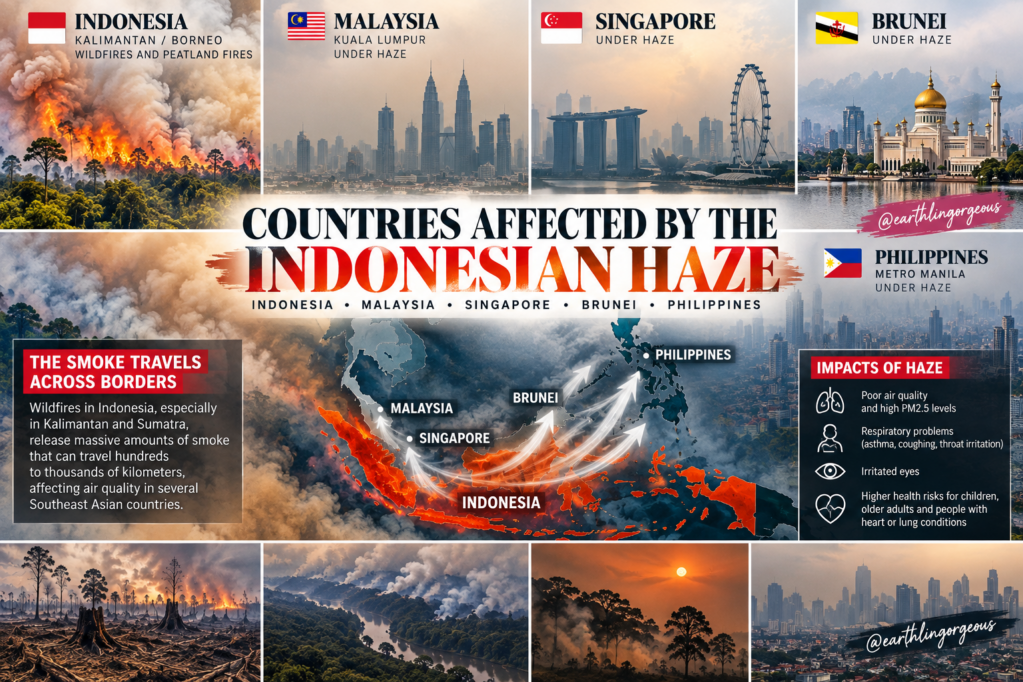
The Indonesian fires have affected air quality across parts of Southeast Asia, including:
Indonesia
Malaysia
Singapore
Brunei
Philippines
The severity varies by location and atmospheric conditions, but the regional nature of the problem is exactly why transboundary haze is such a difficult issue.
One country’s fires can affect the air quality of several others.
And that’s why dealing with this requires regional cooperation — not just one city trying to clean up its own air.
So what is the Philippine government doing?
The Philippine government is monitoring the situation.
The DENR-EMB operates air-quality monitoring stations and tracks pollutants including PM2.5 and PM10.
Government agencies have also been monitoring the movement of the haze and coordinating air-quality and public-health information.
The Department of Health and DENR have advised the public to take precautions when air quality deteriorates, including reducing unnecessary outdoor exposure and using appropriate masks when needed.
That’s important.
But here’s where we, as ordinary people, need to do our part.
Don’t wait for someone to tell you that the air outside looks bad.
Check the air-quality reading for your area.
What should YOU do today?
This is where I want you to stop reading for a second and actually do something.
1. Check your local air quality.
Don’t assume the entire Metro Manila has the same conditions.
Look at the PM2.5/AQI reading for your specific area.
2. Reduce unnecessary outdoor exercise when air quality is unhealthy.
If you were planning a two-hour outdoor workout…
Maybe today isn’t the day.
Move it indoors if possible.
3. If you need to go outside, consider an N95 or equivalent respirator.
A properly fitted respirator can provide much better protection from fine particles than a basic cloth mask.
4. Keep windows closed when outdoor pollution is particularly high.
Especially if you’re near heavy traffic or your local monitoring station is showing poor air quality.
5. If you have an air purifier, USE IT.
This is not the time for your expensive HEPA purifier to become expensive furniture.
Turn it on.
6. Check on vulnerable family members.
If you have children, elderly family members or someone with asthma or another heart or lung condition, pay particular attention to symptoms.
7. Don’t create additional indoor pollution.
If outdoor air is already bad, maybe don’t light five candles, burn incense and fry something for three hours at the same time.
Your lungs have been through enough.
But what if it rains?
Here’s the good news.
Rain can help remove particles from the atmosphere.
PAGASA’s October 1 forecast includes isolated rain showers or thunderstorms over Metro Manila, and changing weather conditions can affect how pollution disperses.
But — and this is important —
One good thunderstorm does not mean the haze problem is over.
Rain can temporarily improve air quality.
It doesn’t automatically extinguish every Indonesian wildfire.
If fires continue burning and winds shift again, haze can return.
So if you wake up tomorrow and the sky looks beautifully clear:
Enjoy it.
But don’t assume the regional fire situation has suddenly disappeared.
So when will the Metro Manila haze finally disappear?
This is the million-peso question.
And unfortunately, anyone giving you an exact date right now is probably giving you more certainty than the atmosphere can actually provide.
The duration depends on:
- how long the Indonesian fires continue
- rainfall in affected areas
- wind direction
- wind speed
- atmospheric mixing
- local Metro Manila pollution
- temperature inversions
- whether smoke continues moving toward the Philippines
Indonesian officials have warned that fires could continue into early November as the rainy season arrives later than expected.
But that does NOT mean Metro Manila will be hazy until November.
The haze over Manila can improve much sooner if winds change or rainfall increases.
It can also temporarily improve and then return.
That’s why this isn’t really a:
“What date will the haze disappear?”
question.
It’s more:
“When will the conditions causing the haze improve?”
And that can change from day to day.
Here’s the good news
You don’t need every fire in Indonesia to be extinguished before Metro Manila’s air can improve.
If we get:
more rain + changing winds + better atmospheric mixing = less smoke accumulating over Metro Manila.
That’s why you might wake up one morning and suddenly think:
“Oh! I can actually see the sky!”
And then two days later…
Never mind.
Haze can fluctuate.
Don’t panic. But don’t ignore it either.
This is probably the most important thing I want you to take away.
You don’t need to panic.
But you also shouldn’t dismiss the haze as “just another cloudy Manila day.”
There’s a difference between panic and awareness.
You don’t have to lock yourself inside your house.
But if your local air-quality reading is showing unhealthy or very unhealthy conditions, maybe don’t spend three hours jogging beside a major highway.
Maybe let the kids play indoors for a while.
Maybe wear an N95.
Maybe close the windows.
Maybe turn on the air purifier you’ve been ignoring.
And definitely check the air quality before deciding that the gray sky is harmless.
And here’s why I think we should ALL care about this
The Metro Manila haze is a reminder of something we don’t think about enough:
Air pollution doesn’t respect borders.
The fire can start thousands of kilometers away.
The smoke can cross the ocean.
And eventually, it can end up over the city where you live.
That’s why this isn’t just an Indonesian problem.
It’s not just a Philippine problem.
It’s a regional Southeast Asian problem.
And it’s also a reminder that climate, weather, urban pollution and human activity are all connected.
What happens somewhere else can eventually affect what’s happening outside your window.
Before you scroll away — do these 3 things
CHECK. PROTECT. SHARE.
CHECK your local PM2.5/AQI reading today.
PROTECT yourself and your family if air quality is unhealthy.
SHARE this article with someone who keeps saying:
“It’s just fog.”
Because it isn’t necessarily fog.
And someone you know might be about to send their kids outside, go for a run, or spend hours outdoors without realizing that the air quality has deteriorated.
Don’t panic. Get informed.
Because you can’t control the wind.
You can’t put out a wildfire in Borneo from Metro Manila.
But you can control what you do when the air quality gets bad.
And honestly?
That’s something worth breathing easier about.
QUICK GUIDE: Metro Manila Haze 2026
WHAT IS HAPPENING?
Parts of Metro Manila are experiencing elevated PM2.5 and unhealthy air-quality conditions.
WHERE IS THE SMOKE COMING FROM?
A significant regional source is wildfire smoke from Indonesia, particularly areas of Kalimantan/Borneo and Sumatra.
IS ALL THE POLLUTION FROM INDONESIA?
No. Metro Manila also has significant local pollution sources, including traffic, industry and other urban emissions.
WHICH COUNTRIES ARE AFFECTED?
Indonesia, Malaysia, Singapore, Brunei and the Philippines have experienced effects associated with the regional haze, although conditions vary.
CAN RAIN HELP?
Yes. Rain can remove airborne particles and changing weather can improve dispersion, but it doesn’t eliminate the source of the fires.
WHEN WILL THE HAZE BE GONE?
There is no exact date. Conditions in Metro Manila can improve sooner depending on rain and wind, while Indonesian fires may continue into early November.
WHAT SHOULD I DO?
Check your local air quality, limit unnecessary outdoor exertion during unhealthy periods, consider an N95 or equivalent respirator outdoors, keep indoor air cleaner and pay attention to vulnerable family members.
One last thing:
If you’re reading this from Metro Manila and the sky outside your window is gray right now…
Look at it differently.
Not as an interesting sunset.
Not as weird weather.
Not as something to complain about on Facebook.
As a reminder to check the air you’re breathing.
Because sometimes the most important thing in the atmosphere…
is the thing you can’t see.

